
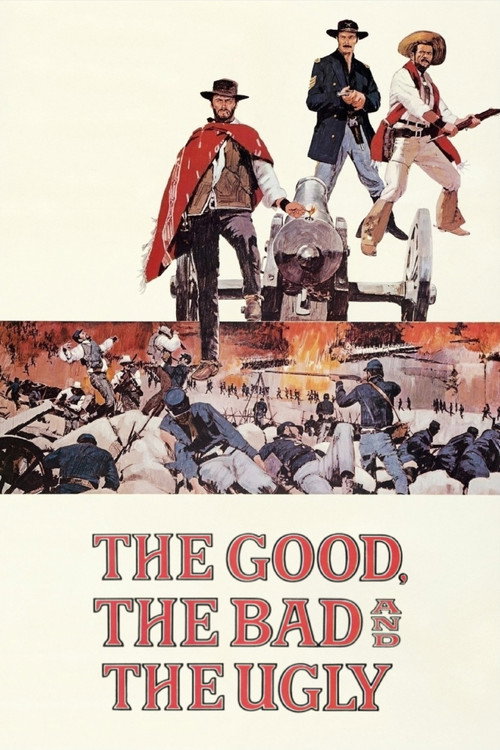
The Good, the Bad and the Ugly (1966) filming locations
- Documented locations
- 32
- Year
- 1966
- Directed by
- Sergio Leone
- Original title
- Il buono, il brutto, il cattivo
Betterville (Carazo)
Carazo, Spain
The scene : Captured by the Union army, Tuco and Blondie are taken to this Northern prisoner-of-war camp at the foot of the Peña de Carazo, where they encounter Sentenza.
Carazo, Spain
The scene : During the summer of 1966, this locality on the banks of the río Mataviejas, a few minutes from Carazo, hosted the filming of the prisoner camp scenes for Betterville.
Arlanza River (Contreras)
Contreras, Spain
The scene : On the bank of the Arlanza, near the monastery of San Pedro de Arlanza, Union and Confederate soldiers fight over the Langstone bridge, which Tuco and Blondin eventually blow up with dynamite.
Monastery of San Pedro de Arlanza
Hortigüela, Spain
Founded in 912, this Benedictine monastery was abandoned in 1841; its ruins are not open to visitors.
The scene : The ruins of the monastery serve as the interiors of the San Antonio mission, converted into a makeshift hospital: Blondin, burned by his crossing of the desert, is tended there by the monks.
Manzanares el Real, Spain
The scene : In this chaos of granite overlooking Manzanares el Real, Blondin captures Tuco for the first time to pocket the bounty, after a shootout against three other bounty hunters.
Dehesa de Navalvillar
Colmenar Viejo, Spain
The western village built in 1963 by Augusto Lega and Félix Michelena on this dehesa was entirely demolished in 1974 to enlarge an army helicopter base; only a few bricks remain.
The scene : On the Western sets standing in this dehesa, Tuco and the Blondin find themselves in the village of White Rocks, where they stage a gunfight in front of Sentenza and his gang.
Colmenar Viejo, Spain
The scene : The hills visible in a shot from the film were located here, southeast of Colmenar Viejo, from the road running alongside the wastewater treatment plant near exit 29 of the M-607.
Mini Hollywood (Tabernas)
Tabernas, Spain
Western-style village built in 1965 under the name Poblado del Fraile, later renamed Yucca City and then Mini-Hollywood, and now the Oasys theme park; its streets served as the setting for dozens of westerns.
The scene : Abandoned in the middle of the desert, Tuco crosses a rickety bridge to reach the town, walks up the main street toward the gunsmith's shop, then settles into the hotel; the set also stands in for the towns of Santa Ana and Valverde.
Tabernas, Spain
The scene : The landscapes of Tuco and Blondie's escape, following a hanging that nearly went wrong, can be recognized from the road overlooking the northern edge of the park.
Gádor, Spain
Land of the private estate Las Lomillas, near the Travertinos de Sal.
The scene : The eroded ridges of this area south of Tabernas, also known as Las Salinas or Las Lomillas, appear in several shots of the film, identified by the line of hills.
Gádor, Spain
The scene : The Union army advances along this boulevard, so thick with dust that one might mistake them for Confederates.
Tabernas, Spain
The scene : On this desert set, Blondin breaks off the partnership and abandons Tuco in the middle of the desert.
Tabernas, Spain
The scene : Indifferent to Tuco's protests, Blondin rides off on horseback across this landscape, east of the highway and north of the Leone Western set.
La Sartenilla (Tabernas)
Tabernas, Spain
The scene : On this set near the main road, a ghost-town backdrop hosts the very first sequence: Tuco faces off against three bounty hunters there.
Tabernas, Spain
The scene : On this track climbing into the Sierra Alhamilla, east of Mini Hollywood, Leone shot a riding sequence that was reused as is in « Pour quelques dollars de plus », where Clint Eastwood was already riding down this slope.
Cortijo Monterreal (Tabernas)
Tabernas, Spain
The scene : Before reaching the San Antonio mission, Tuco and Blondin arrive at a Confederate camp set up in this canyon, nicknamed Apache Canyon, beside the road to Castro de Filabres.
Almería, Spain
The scene : Tuco sweeps his gaze over the dunes of Mazarrulleque, just west of the Rambla de Morales.
Almería, Spain
The scene : Le Blondin and Tuco cross this desert, at the foot of the three-peaked silhouette of the Sierra de Cabo de Gata.
Cortijo del Fraile
Níjar, Spain
Former farm built in the 18th century by the Dominicans of Almería; a murder committed here in 1928 inspired Federico García Lorca's play "Blood Wedding".
The scene : After crossing the desert, Tuco drives Blondin, burned by the sun, to the San Antonio mission near Los Albaricoques, where he finds his brother Pablo, the prior of the place; the two men leave again once Blondin has recovered.
Cortijo del Campillo de Doña Francisca
Níjar, Spain
The scene : In the opening scene, Sentenza arrives from the north at the Stevens farm, where a boy turns the waterwheel with a donkey, before going inside to seek information about the loot from a robbery.
Cortijo de la Hoya Altica
Almería, Spain
The scene : The interiors of Stevens' farmhouse, where Sentenza comes to seek information about the loot from a robbery, were shot in this cortijo by the road to Cabo de Gata.
Níjar, Spain
The scene : In front of this hamlet takes place the hanging of Shorty Larson, whom the Blondin is about to rescue; it is also here that Tuco begins his vengeance against the Blondin.
Níjar, Spain
This coastal fortress, built in 1764 to defend the shoreline between Almería and Málaga, is listed as a site of cultural interest; it became a private residence in the mid-19th century.
The scene : Chased along the beach of El Playazo, Tuco and Blondin pass this coastal fort and come across a Confederate camp.
Níjar, Spain
The scene : The road descending from Rodalquilar toward the El Playazo beach sees several of the film's great horseback sequences pass through it.
La Calahorra railway station
La Calahorra, Spain
The scene : On the plain north of La Calahorra, this station sees the convoys of Southern prisoners depart; it is near here that Tuco, lying across the body of Sergeant Wallace, lets the train sever the chain that binds them together.
La Calahorra, Spain
The scene : On these rails, Tuco ties Sergeant Wallace's body so that the passing train will snap the chain of his handcuffs.
La Calahorra, Spain
12 km branch line built in 1899 by The Alquife Mines and Railway Co. Ltd. to connect the Alquife mines to La Calahorra station; the track has been removed and its route has become a path.
The scene : The former mining branch line that connected the Alquife mines to the main railway line was used for the film's train scenes.
Titanus Elios
Rome, Italy
The scene : The town where Blondin hands Tuco over to the sheriff to collect the bounty, then shoots through the rope of his hanging, is a Western set from those Roman studios.
Gádor, Spain
The scene : In front of a rock on the rambla, at the foot of the motorway and beside the current viewpoint "El Bueno, El Feo y El Malo", Tuco and the Blondie split the bounty they have just collected; the site is reached from the Alfaro service station, hence the name "Rambla Alfaro".
Santo Domingo de Silos, Spain
The scene : In this circular cemetery lost at the bottom of a valley, Blondin, Sentenza and Tuco face off in the famous final "triel": the gold is hidden near the grave of Arch Stanton, marked "Unknown", and Tuco ends up with the noose around his neck before Blondin rides away on horseback.
Rome, Italy
One of the major production complexes in Europe, featuring stages, workshops, set construction facilities, and a large backlot.
The scene : Filming began at the Roman studios, where the sequence in which the Blondin hands Tuco over and then cuts him free from the rope was shot.
Ancient Tuff Quarries of Salone
Rome, Italy
Quarried from the 1st century BC onwards by Lucullus, these quarries supplied tuff for the Colosseum, transported via the Aniene.
The scene : In these tufa quarries, Tuco comes to recruit his former gang; the scene was cut in editing.
Filming locations by city
- Filming locations in Rome — 37 movies
Filmed at the same locations
- For a Few Dollars More (1965) — 9 locations in common
- Conan the Barbarian (1982) — 3 locations in common
- Indiana Jones and the Last Crusade (1989) — 3 locations in common
- Angelique (1964) — 1 location in common
- Austerlitz (1960) — 1 location in common
- Coco Chanel (2008) — 1 location in common